
How to *actually* improve your writing
It took me 5½ years to learn these 4 lessons

Between 2016 (while in university) and 2023 (when I started TTRH), my writing barely improved:
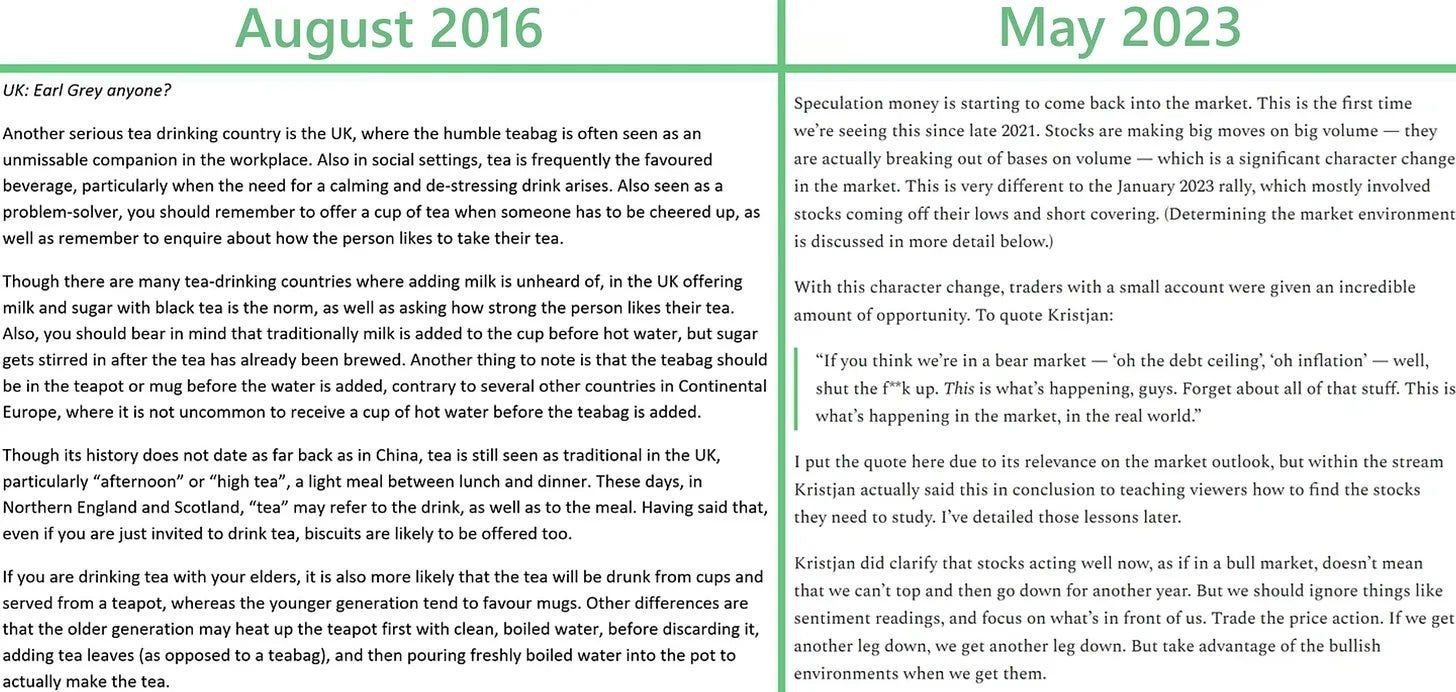
To make matters worse, I’d been working as a professional writer from January 2018.
5½ years of being paid to write had made no meaningful difference.
The true improvement only happened after I began writing online. That’s when I stopped getting feedback from ‘professional writers’, and started getting feedback from actual readers.
Turns out that all the conventional stuff I’d been taught was wrong.
If you want to level up your writing, this is what moves the needle:
1. Write every day.
You don’t become good at an activity unless you practise often.
Put in the reps. Build the muscle. And the easiest way to do both is by building a daily writing habit. (Even if it’s just a tweet.)
I didn’t meaningfully improve in the first 5 years of my writing career because, even though my job title was “Technical Writer”, I spent most of my time copy-editing. (So much so that I became decent at that instead…)
Fixing the same mistakes over and over again was depressing, so it was always a relief when I could get back to my writing. Unfortunately, interruptions were so frequent that writing progress was slow. Writing about technical topics without access to technical experts slowed progress even more.
All in all, I wasn’t putting in the reps — and it showed.
2. Shorten your feedback loop.
Starting to tweet and publish on TTRH marked a turning point — and not just because I was writing more.
My feedback loop had shortened: I wrote shorter content — tweets and stacks, not papers and books — and therefore published much faster. Remember: you need quantity to get to quality. (I may have slowed down on TTRH, but am still ‘shipping’ daily via long tweets, client work and this newsletter. Got to put in those reps!)
The other meaningful change was that I had direct contact with readers. I wasn’t handing over the content for someone else to publish, after which I’d never hear about it again — I published it myself, so readers told me directly what did and didn’t work.
Combine that with the short feedback loop, and you can iterate quickly.
To see the impact, check the TTRH archive. While I now cringe at my old writing, I value having my progress documented.
3. Fix your formatting.
Any idiot can learn to format properly overnight, which is why it always amazes me how many clever people don’t bother.
Have you ever looked at a wall of text and decided you can’t be bothered to read it?
That has more to do with a lack of formatting than with length. Even at a paragraph level, you’re more likely to skip an 8-liner (or more accurately, read just the first couple of lines), but would be more likely to read those same 8 lines properly if you broke up that paragraph into a 1-3-3-1 format.
Add headings into the mix, and you’re also giving readers signposts. Throw lists in there too, and your writing becomes more appealing than what most ‘professional’ writers produce.
Anyone can learn this. And it instantly makes your writing clearer.
I demonstrated this on my own writing from 2016 (used at the start of this newsletter) here.
4. Be different.
Using AI and chasing algorithms make you sound like everyone else.
…and that makes your content boring. No faster way to make people forget your words.
As a trader, you can do extremely well for yourself without being the very best. You can even trade broadly the same strategy as other market participants, from the names you trade to the rules you follow, and outperform.
That’s not the game of content.
Here, you need to be unique. That can be a tiny niche, but the key is to be different — which is easiest by showing what’s naturally unique: YOU. Your personality.
What makes you weird?
Personally, I like long, in-depth reads. I like picking people’s brains. And I like collecting lots of ‘puzzle pieces’, preferably from unstructured sources, then figuring out the picture on the box — i.e. weaving all those pieces together and making them flow seamlessly.
The more I leaned into these ‘weird’ things, the better my content became.
And the more you lean into what makes you different, the better yours will be.
- Kyna
Point 4 is the one most people misread. The argument isn't "don't use AI." It's that AI can help you produce — but it can't supply the thing that makes writing worth reading in the first place. The raw material is irreplaceable: what you've actually seen, done, and gotten wrong.
I write about Japanese manufacturing quality methods applied to knowledge work. I use AI heavily in the process. But the content that performs is always the content rooted in something I watched happen on a factory floor — not something a model could have generated from first principles.
AI is a production accelerator. It doesn't create source material. That part is still entirely yours.
I always enjoy your posts, Kyna. It’s very nice to encounter people who continue to be passionate about one of life’s most essential skills - clear written communication. I wonder how many schools and Universities currently make the effort to teach teenagers these skills and to instill in them an understanding of why the ability to write well is so valuable. Good writing is at once all about pulling thoughts out of our heads, whilst at the same time organizing those thoughts and expressing them in a way that makes ourselves a little more understandable to others. Good writing can be informative, inspiring, persuasive and memorable in equal measure. The quality of our thinking is determined not only by our experiences and knowledge but also by our mastery (or otherwise) of language and our ability to articulate our reflections in words that engage others.